What is AI? If you have found yourself asking this exact question lately, you are definitely not alone. Over the last couple of years, artificial intelligence has completely shifted from a niche sci-fi concept into the absolute center of our daily lives. It is in our phones, our workplaces, our search engines, and even our coffee makers. But despite how often we hear the term, very few people actually understand what it truly means, how it functions behind the scenes, or where it even came from.
When people ask, “What is AI?”, they usually picture sentient robots taking over the world, thanks to Hollywood. But the reality is both much simpler and far more fascinating. In this ultimate guide, we are going to strip away the jargon, the hype, and the confusion. We will dive deep into exactly what is AI, uncover the brilliant history behind it, break down the complex mechanics of how it actually works, and look at the top tech giants racing to build the future. Let’s get started.
What is AI? The Core Definition
To put it as simply as possible, AI, or Artificial Intelligence, refers to the simulation of human intelligence processes by machines, especially computer systems. When you ask, “What is AI?”, you are really asking about a machine’s ability to mimic human cognitive functions. This includes learning from new information, reasoning through complex problems, understanding human language, correcting mistakes, and perceiving the environment.
According to leading researchers at IBM, artificial intelligence is not just one single technology. Instead, it is a massive umbrella term that encompasses a wide variety of subfields and technologies.
Breaking Down the Types of AI
To truly understand what is AI, we have to categorize it. Experts generally divide artificial intelligence into three distinct evolutionary stages:
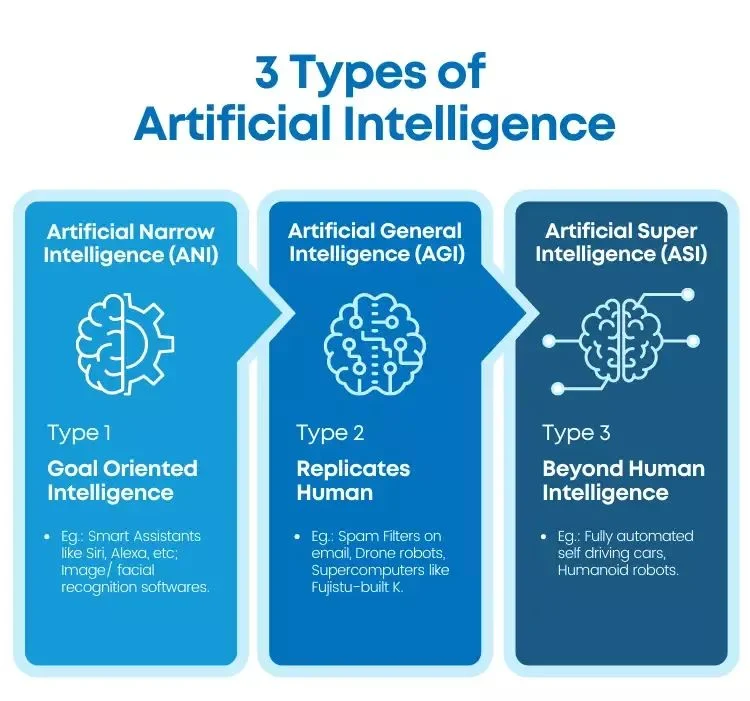
1. Narrow AI (or Weak AI) This is the only type of AI that exists today. Narrow AI is designed and trained to perform a specific, singular task. It might seem incredibly smart, but it operates within a strictly defined boundary. When you ask Siri for the weather, use Netflix’s recommendation algorithm, or let a self-driving car navigate a highway, you are using Narrow AI. It does not “think” outside the box.
2. General AI (or Strong AI / AGI) This is the holy grail of artificial intelligence. AGI would be a machine that possesses human-level intelligence, with the ability to understand, learn, and apply knowledge across a vast array of independent tasks—just like a human being can. If you ask an AGI system to write a poem, balance a spreadsheet, and fix a car engine, it could theoretically do all three with equal proficiency. As of right now, General AI does not exist; it remains purely theoretical.
3. Artificial Superintelligence (ASI) This is the stuff of science fiction. ASI refers to a future where artificial intelligence surpasses human intelligence and capability across the board. A machine with ASI wouldn’t just be as smart as us; it would be smarter than the smartest human minds combined in creativity, problem-solving, and social skills.
How AI Actually Works: A Peek Under the Hood
So, we know what is AI on a conceptual level. But how does a piece of silicon and code actually learn to recognize a dog in a photo, or translate English to Japanese flawlessly? It all comes down to a few core pillars.
Data: The Fuel of the Machine
If artificial intelligence is a car, data is the gasoline. AI systems cannot learn anything without massive amounts of data. Every time you upload a photo, write an email, or make a purchase, you are generating data. When developers build an AI, they feed it millions of examples. If you want an AI to recognize cats, you don’t program it with rules like “cats have pointy ears and whiskers.” Instead, you feed it 10 million pictures of cats and let the system figure out the common patterns on its own.
Machine Learning (ML)
Machine Learning is the engine of modern AI. Instead of writing explicit, step-by-step code for every single scenario, engineers use ML algorithms that allow the computer to learn from the data directly. The more data the ML model processes, the better and more accurate it becomes. There are three main types of machine learning:
- Supervised Learning: The AI is trained on labeled data. You give it thousands of pictures explicitly labeled “cat” or “dog,” and it learns to differentiate between the two.
- Unsupervised Learning: The AI is given unlabeled data and told to find hidden patterns on its own. For example, a grocery store might use this to group shoppers into different demographics without telling the AI what those demographics are beforehand.
- Reinforcement Learning: This is how AI learns to play video games or drive cars. The AI is placed in an environment and told to maximize a “reward.” If it makes a good move, it gets a digital treat. If it crashes the car, it gets a penalty. Over millions of attempts, it learns the optimal strategy. You can see this in action with AI systems like Google DeepMind’s AlphaGo.
Deep Learning and Neural Networks
To understand what is AI today, you absolutely must understand Deep Learning. Deep learning is a highly advanced subset of machine learning. It utilizes something called an Artificial Neural Network—a structure heavily inspired by the literal biological neurons in the human brain.
Imagine millions of tiny digital switches connected to each other in layers. Data enters the first layer, passes through hidden layers where it is processed, and spits out an answer at the end. The “deep” in deep learning just means there are many hidden layers. This technology is what powers facial recognition, voice assistants, and, most famously, generative AI like ChatGPT.
Natural Language Processing (NLP)
Have you ever wondered how a machine understands your sarcastic text message? That is the magic of NLP. Natural Language Processing is a branch of AI that helps computers understand, interpret, and manipulate human language. It bridges the gap between human communication and computer understanding. Whenever you use spell check, ask Alexa a question, or run a Google search, NLP is working behind the scenes to make sense of your words.
The Fascinating History of AI
People often think artificial intelligence is a brand-new invention, but the concept has been haunting the minds of mathematicians and philosophers for centuries. To fully grasp what is AI, we have to look at where it came from.
The Early Dreams (1940s – 1950s)
The formal birth of AI is often traced back to the summer of 1956 at Dartmouth College. A group of pioneering scientists—including John McCarthy, Marvin Minsky, Allen Newell, and Herbert A. Simon—gathered for a workshop. It was here that McCarthy officially coined the term “Artificial Intelligence.”
But the groundwork was laid even earlier. In 1950, the brilliant British mathematician Alan Turing published a famous paper titled “Computing Machinery and Intelligence.” In it, he asked the question, “Can machines think?” and proposed the legendary “Turing Test”—a way to determine if a computer could exhibit intelligent behavior indistinguishable from that of a human.
The First AI Winter (1970s – 1980s)
In the 1960s, optimism was sky-high. Researchers believed they could create General AI within a decade. But they quickly hit a wall. Computers of that era were painfully slow, had tiny memories, and lacked the massive amounts of data required to make AI work. Funding dried up, and the industry entered what is known as an “AI Winter”—a period of intense skepticism, slashed budgets, and stagnation.
The Boom of Big Data and Deep Learning (2000s – 2010s)
The ice began to thaw in the late 1990s when IBM’s Deep Blue supercomputer defeated the world chess champion, Garry Kasparov. But the real explosion happened in the 2010s.
Three major things happened simultaneously:
- Big Data: The internet generated unimaginable amounts of data.
- Better Hardware: Graphics Processing Units (GPUs), originally designed for video games, were repurposed to run neural networks at lightning speed.
- Algorithm Breakthroughs: Scientists figured out how to make deep neural networks actually work well.
In 2012, a deep learning model significantly outperformed traditional algorithms in an image recognition competition, proving that deep learning was the future.
The Generative AI Era (2020s – Present)
This brings us to today. When people ask “What is AI?” right now, they are usually thinking of Generative AI. In late 2022, a small research company called OpenAI released ChatGPT to the public. It could write essays, code websites, and pass the bar exam. It felt like a massive leap forward. Suddenly, every major tech company on earth pivoted to AI, sparking the greatest technological arms race in human history.
What is AI Doing Today? Real-World Applications
Understanding the theory is great, but seeing it in action is better. If you are still wondering what is AI actually doing for you right now, look around.
- Healthcare: AI algorithms are currently analyzing medical images (like X-rays and MRIs) to detect cancers and diseases earlier and more accurately than human doctors. Companies are also using AI to discover new life-saving drugs in a fraction of the time it used to take.
- Finance: Every time your credit card is swiped, an AI system analyzes the transaction in milliseconds to determine if it’s fraudulent. Wall Street relies heavily on algorithmic trading, where AI makes split-second stock trades based on market trends.
- Everyday Convenience: When Google Maps reroutes you around a traffic jam, that’s AI predicting traffic flow. When Spotify creates a personalized “Discover Weekly” playlist for you, that’s a machine learning algorithm analyzing your listening habits.
The Top AI Companies Shaping the Future
To understand what is AI, you have to know the players building it. The current AI landscape is a fierce battleground between massive tech giants and nimble startups.
OpenAI
You cannot talk about AI without mentioning OpenAI. Originally founded as a non-profit research lab (with early backing from Elon Musk), it transitioned to a for-profit model. They are the creators of GPT-4, DALL-E (which generates art from text), and Sora (a groundbreaking video generator). They essentially kicked off the generative AI craze.
Google DeepMind
Google has been a powerhouse in AI for over a decade. They acquired DeepMind in 2014, which later created AlphaGo. Google integrates AI into almost all of its products under the “Gemini” banner. Their massive search engine is entirely dependent on AI to deliver relevant results to your queries.
Microsoft
Microsoft has strategically partnered with OpenAI, investing billions of dollars to integrate GPT-4 into its ecosystem. If you use the new Copilot in Windows, or the AI features in Microsoft Word and Excel, you are experiencing Microsoft’s vision for an AI-assisted workplace.
Meta (Facebook)
Mark Zuckerberg’s company is taking a slightly different route. Instead of just building one central AI, Meta is heavily investing in “open-source” AI models, like their Llama series. They believe that making AI accessible to developers worldwide will accelerate innovation and ultimately support their vision of the Metaverse.
Anthropic
Founded by former OpenAI executives, Anthropic is the creator of “Claude”—an AI chatbot widely considered to be the primary rival to ChatGPT. Anthropic focuses heavily on “AI Safety,” building models that are less likely to produce harmful or biased outputs.
The Ethical Dilemma: Bias, Jobs, and the Future
We cannot have a complete discussion about what is AI without addressing the elephant in the room: the risks. Artificial intelligence is an incredibly powerful tool, and like any powerful tool, it can be used for good or for harm.
Will AI Replace Human Jobs?
This is the number one fear people have. The honest truth? Yes, AI will replace some jobs. If your job consists entirely of repetitive, data-entry tasks, or basic copywriting, AI can probably do it faster and cheaper. However, history shows us that technology also creates new jobs. Just as the internet killed the travel agent but created the web developer, AI will kill certain roles but spawn entirely new industries we can’t even imagine yet. The future belongs to people who learn to use AI as a tool, rather than those who compete against it.
The Problem of AI Bias
Remember how I said AI learns from data? Well, if the data is flawed, the AI will be flawed. Because AI systems are trained on internet data—which is full of human prejudices—AI models have been caught displaying racist, sexist, and biased behavior. For example, AI hiring tools have been found to automatically downgrade female applicants’ resumes because the historical data favored men. Fixing AI bias is currently one of the most critical fields of research. You can read more about algorithmic bias from researchers at MIT.
The Black Box Problem
Deep learning models are incredibly complex. Sometimes, even the engineers who built them don’t fully understand why the AI made a specific decision. This is called the “black box” problem. If an AI denies you a bank loan, or misdiagnoses a patient, we need to know why. Without transparency and explainability, trusting AI in high-stakes situations is incredibly dangerous.
Conclusion: Embracing the AI Revolution
So, let’s circle back to our original question: What is AI?
Artificial Intelligence is not a magical, sentient being waiting in the shadows. It is a highly sophisticated, deeply complex set of mathematical models and algorithms designed to recognize patterns in massive amounts of data. It is a mirror reflecting human knowledge back at us in new, useful, and sometimes surprising ways.
From the early theoretical dreams of Alan Turing to the mind-blowing generative AI tools we have in our pockets today, the journey of AI has been nothing short of extraordinary. Companies like OpenAI, Google, Microsoft, and Anthropic are pushing the boundaries of what machines can do at a blistering pace.
Yes, there are real challenges ahead. We have to figure out how to handle job displacement, how to strip bias from algorithms, and how to ensure these systems remain safe as they grow more powerful. But the potential benefits—curing diseases, solving climate change, democratizing education—are too massive to ignore.
The AI revolution isn’t coming; it is already here. The best thing you can do is not to fear it, but to understand it.
Frequently Asked Questions (FAQs)
What is AI in simple terms? In simple terms, AI is a computer system designed to perform tasks that normally require human intelligence, like understanding language, recognizing images, or making decisions.
What is the difference between AI and Machine Learning? AI is the broad concept of machines acting intelligently. Machine Learning is a specific method of achieving AI where we give the machine data and let it learn on its own, rather than programming it with strict rules.
Is Artificial Intelligence dangerous? AI can be dangerous if used maliciously (like creating deepfakes or cyberattacks) or if it is poorly regulated in critical areas like healthcare or weapons. However, current AI is not sentient and does not have its own intentions or desires to cause harm.
Can AI think like a human? No. While AI can simulate human conversation and solve complex problems, it does not have consciousness, feelings, or true understanding. It is simply processing data and predicting the most statistically likely outcome.
What is AI going to look like in 10 years? In the next decade, AI will likely become seamlessly integrated into every aspect of our lives. We will probably see highly capable personal AI assistants that can manage our schedules, advanced autonomous vehicles, and major breakthroughs in scientific research powered by AI.
About The Author