
what is prompt engineering
What is prompt engineering? If you have spent any time online recently, you have probably heard this exact phrase thrown around by tech enthusiasts, marketers, and developers. But when you sit down and actually ask yourself, “What is prompt engineering?”, the answer can feel surprisingly slippery.
We are living in a bizarre new era of technology. For the first time in human history, you don’t need to know how to write computer code to control a computer. You just need to know how to write clear, effective English. That is the absolute core of prompt engineering. It is the art and science of talking to machines in a way that forces them to give you exactly what you want.
In this comprehensive guide, we are going to rip the band-aid off this confusing topic. If you are wondering what is prompt engineering, you are going to get a massive, deep-dive explanation. We will cover the history, the mechanics, the advanced frameworks, and the common mistakes people make. By the end of this, you will never have to Google “what is prompt engineering?” ever again.
What is prompt engineering? The Core Definition
Let’s start with the absolute basics. What is prompt engineering?
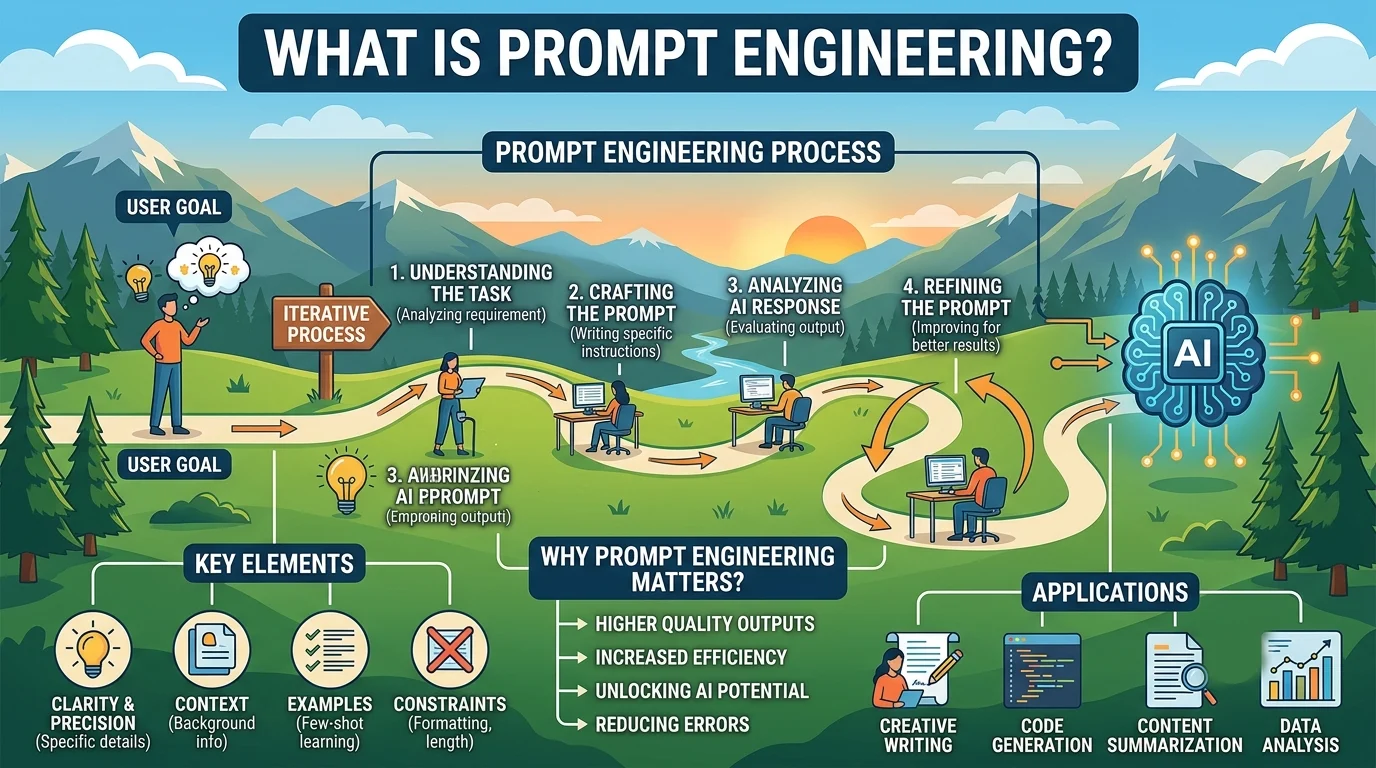
At its simplest level, a “prompt” is just the text you type into an AI tool like ChatGPT, Claude, or Gemini. “Engineering” is the process of designing, building, and refining something to work perfectly. Therefore, what is prompt engineering? It is the process of designing and structuring the text instructions you give to an artificial intelligence so that the AI generates the most accurate, relevant, and useful output possible.
Think of it like dealing with a highly intelligent, incredibly fast, but completely literal-minded alien intern. If you give that intern vague instructions, they will give you a vague, useless result. But if you learn prompt engineering, you learn how to give that intern the exact context, constraints, and format they need to produce a masterpiece.
According to leading researchers at OpenAI, the way you format your input drastically changes the quality of the output. When people first ask, “What is prompt engineering?”, they often think it’s just about typing better questions. But it is actually about learning the psychological quirks of large language models.
The Alternative: AI Prompting Techniques
Throughout this article, when we discuss prompt engineering, we will also be discussing AI prompting techniques. These are the specific, actionable methods you use to structure your thoughts. AI prompting techniques are the tools in your toolbox, while understanding prompt engineering is understanding how to build the whole house.
Why Do We Need to Ask “What is prompt engineering?”
You might be thinking: “Why do I care? I just type ‘write a blog post about dogs’ and it works fine.”
To understand why the question of what is prompt engineering is so vital, you have to understand how AI actually works. As we discussed in previous guides, AI models do not “think.” They are massive mathematical prediction engines. They calculate the statistical probability of which word should come next based on their training data.
Because they don’t truly understand meaning, they are highly susceptible to going off the rails. They might hallucinate fake facts, adopt a weird tone, or completely miss the point of your request. This is exactly why the discipline of what is prompt engineering was born.
When you master what is prompt engineering, you are essentially learning how to steer a massive, chaotic ocean of mathematical probabilities toward a specific, useful island. The difference between a novice and someone who understands prompt engineering is the difference between getting a generic, robotic paragraph and getting a polished, expert-level piece of content that sounds exactly like you.
The History Behind “What is prompt engineering?”
The concept didn’t just appear out of nowhere. To fully grasp prompt engineering, we have to look at its rapid evolution.
The Early Days of Asking “What is prompt engineering?”
In the very early days of text-based AI (just a few years ago), models were incredibly fragile. If you wanted a specific format, you often had to use bizarre, coded tricks. For example, early researchers trying to figure out what is prompt engineering would use phrases like “Translate the following English text to French: [TEXT]” or they would use arcane tokens to force the AI to stop talking.
Back then, prompt engineering was a highly technical skill restricted to PhD researchers at places like Google DeepMind and OpenAI. They were the only ones with access to the models, and they spent months discovering weird quirks—like how starting a prompt with “A wise man once said…” would make the AI sound profoundly philosophical.
The Consumer Boom and What is prompt engineering
Then, ChatGPT was released to the public in late 2022. Suddenly, millions of regular people were interacting with AI, and they all ran into the same problem: the AI was stubborn, lazy, and prone to making things up.
The phrase “what is prompt engineering” exploded on Google search trends. Everyday users realized that talking to a machine wasn’t as intuitive as they thought. A whole new industry of “prompt engineers” emerged, with some companies even offering $300,000 salaries to people who could prove they knew prompt engineering and how to make models perform complex tasks reliably.
The Core Mechanics: What is prompt engineering in Practice?
Now, let’s get our hands dirty. If someone asks you, “What is prompt engineering?”, how do you actually do it? What are the fundamental building blocks?
1. Context is King in What is prompt engineering
The number one mistake people make is being too brief. If you just type “write about marketing,” the AI has zero context. It doesn’t know who the audience is, what the tone should be, or how long it should be.
A core pillar of prompt engineering is providing a massive amount of background context. You have to tell the AI who it is, who it is talking to, and what the goal is.
Bad Example: “Write an email to my boss asking for a raise.” Good Example (Using What is prompt engineering): “Act as a senior marketing manager who has been with the company for 3 years. Write a polite but firm email to your direct supervisor, Sarah. The goal is to ask for a 10% raise based on the fact that you just successfully launched a campaign that increased company revenue by 25%. Keep the tone professional, data-driven, and appreciative.”
Notice the difference? That is the power of what is prompt engineering. You are removing all the guesswork for the AI.
2. Specificity and Constraints in What is prompt engineering
AI models naturally want to be helpful, which often means they ramble. A crucial part of mastering what is prompt engineering is learning how to apply constraints. You must tell the AI what not to do, and give it strict boundaries.
If you are learning prompt engineering, you should always ask yourself: “Did I tell the AI how long the response should be? Did I tell it what format to use? Did I tell it what words to avoid?”
Example of Constraints in What is prompt engineering: “Write a summary of the book ‘Atomic Habits’. Do not exceed 200 words. Use bullet points for the main takeaways. Do not use adjectives. Do not include an introduction or conclusion.”
3. Role-Playing and What is prompt engineering
One of the most powerful AI prompting techniques is persona adoption. Large language models have read practically every piece of text on the internet. This means they can simulate almost any personality or profession.
When you utilize role-playing as part of prompt engineering, you instantly change the quality of the output. Instead of asking for generic advice, you ask an expert.
Example: “Act as a cynical, highly experienced, straight-talking New York real estate broker. Explain to a first-time homebuyer why they shouldn’t buy a house right now.”
By assigning this role, you have just bypassed the AI’s default, overly polite tone. This is a quintessential aspect of prompt engineering.
Advanced Strategies: What is prompt engineering Masters Know
Once you understand the basics of context, constraints, and roles, you can move on to advanced AI prompting techniques. This is where the real magic of what is prompt engineering happens.
Chain of Thought: The Hidden Gem of What is prompt engineering
If there is one advanced technique you learn from this guide on prompt engineering, let it be Chain of Thought (CoT).
Normally, if you ask an AI a complex logic puzzle or a multi-step math problem, it will just spit out the final answer. And quite often, that final answer will be completely wrong. Why? Because it tried to predict the final answer in one single leap.
Chain of thought is an AI prompting technique where you force the model to show its work. You literally instruct the AI to “think step by step.”
How to use Chain of Thought in What is prompt engineering: Instead of asking: “How many golf balls fit in a school bus?” You ask: “How many golf balls fit in a school bus? Think step by step, explaining your calculations and assumptions before giving the final number.”
Researchers at Google found that simply adding the phrase “Let’s think step by step” to the end of a prompt drastically improved the AI’s ability to solve complex reasoning tasks. If you want to truly understand what is prompt engineering, you must understand Chain of Thought.
Few-Shot Prompting: Teaching by Example
Another pillar of advanced prompt engineering is Few-Shot prompting.
“Zero-shot” means you just give the AI an instruction with no examples. “Few-shot” means you give the AI a few examples of the input and the desired output before you give it your actual task.
This is one of the most reliable AI prompting techniques because it allows you to show the AI exactly what you want, rather than trying to describe it with words.
Example of Few-Shot in What is prompt engineering:Prompt: “Convert the following positive statements into sarcastic statements. Statement: I love sitting in traffic. Sarcastic: Oh boy, sitting in traffic is exactly how I wanted to spend my afternoon. Statement: Rain is my favorite weather. Sarcastic: Nothing beats getting soaked by freezing rain. Statement: I really enjoy paying taxes. Sarcastic:”
By providing examples, you have completely eliminated the ambiguity. This is what is prompt engineering at its finest.
Negative Prompting: What is prompt engineering Exclusions
Sometimes, telling the AI what you don’t want is just as important as telling it what you do want. Negative prompting is a specific sub-skill within prompt engineering.
If you find the AI is using too much jargon, you add a negative constraint: “Do not use any technical jargon. Avoid words like ‘synergy’, ‘leverage’, or ‘optimize’.” Mastering prompt engineering means learning to anticipate the AI’s default bad habits and cutting them off at the pass.
The Top AI Prompting Techniques Frameworks
To systematize what is prompt engineering, experts have created frameworks. When people ask, “What is prompt engineering?”, I usually point them to these established structures.
The R-T-F Framework for What is prompt engineering
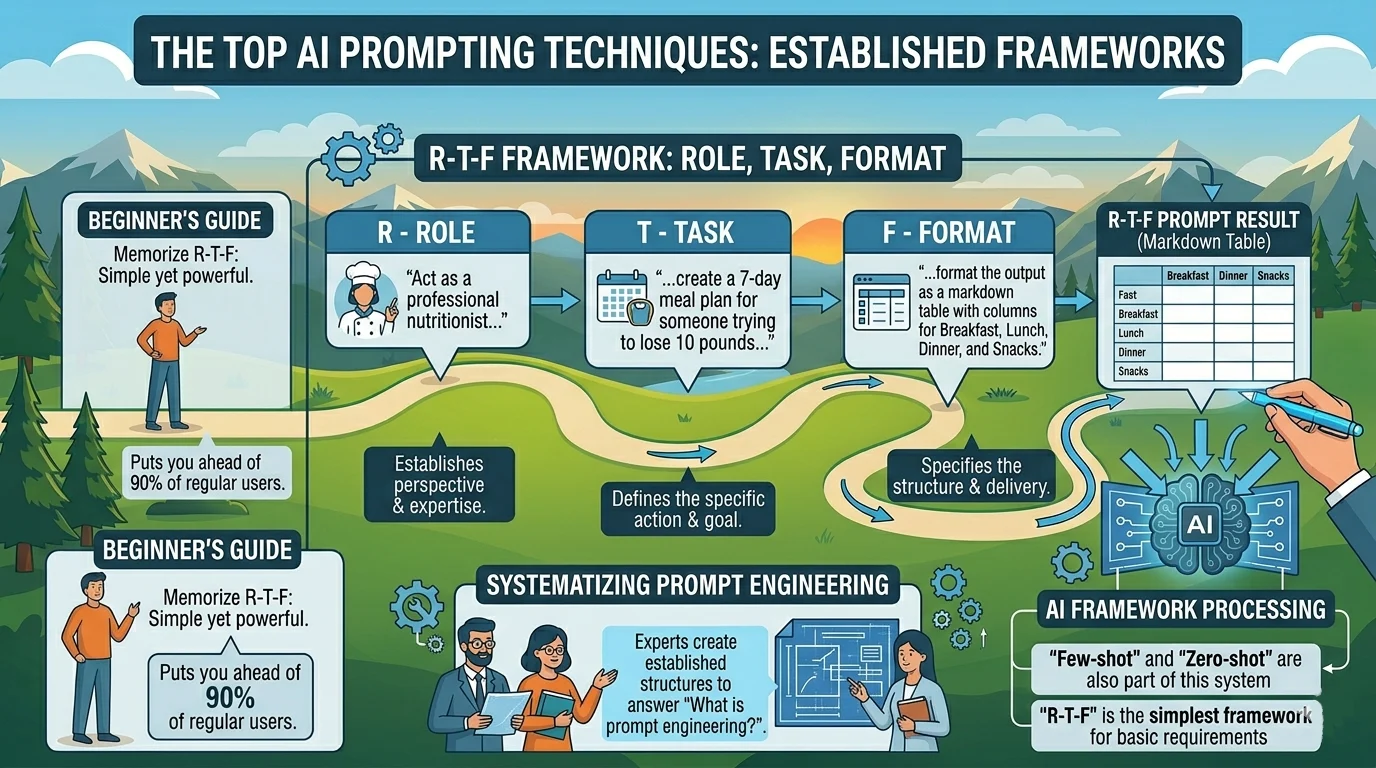
This stands for Role, Task, Format. It is the simplest way to ensure you are hitting the basic requirements of prompt engineering.
- Role: “Act as a professional nutritionist…”
- Task: “…create a 7-day meal plan for someone trying to lose 10 pounds…”
- Format: “…format the output as a markdown table with columns for Breakfast, Lunch, Dinner, and Snacks.”
If you are a beginner asking prompt engineering, just memorizing R-T-F will put you ahead of 90% of regular users.
The C-A-R-E Framework for What is prompt engineering
For more complex tasks, prompt engineering requires deeper structure. CARE stands for Context, Action, Result, Example.
- Context: Give the background (I am writing a welcome email for new subscribers).
- Action: What should the AI do? (Write a 300-word email).
- Result: What is the desired outcome? (The reader feels welcomed and clicks a link to a free ebook).
- Example: Provide a snippet of your own writing style so the AI can mimic your voice.
Utilizing frameworks like CARE is exactly prompt engineering looks like in the corporate world.
Common Mistakes When Learning What is prompt engineering
Even when you know the theory of prompt engineering, it is easy to mess up in practice. Let’s look at the pitfalls.
Being Too Polite in What is prompt engineering
Humans are conditioned to be polite. We say “Please” and “Could you maybe…” AI doesn’t care about politeness. In fact, excessive politeness can actually confuse the model and dilute your instructions. When practicing what is prompt engineering, be direct, authoritative, and clear. “Write a 500-word essay” is vastly superior to “If you don’t mind, could you possibly write an essay that is around 500 words or so?”
Overloading the Prompt: What is prompt engineering Balance
When people first learn prompt engineering, they often go overboard. They write a 1,000-word prompt with 50 different constraints. The problem is that AI models have a “context window” (a limit on how much text they can process at once). If your prompt is a messy wall of text, the AI will get confused and start ignoring instructions. Good prompt engineering requires brevity and structure. Use line breaks, bullet points, and clear headings within your prompt itself.
Ignoring Iteration in What is prompt engineering
No one writes a perfect prompt on the first try. A massive part of prompt engineering is iteration. You write a prompt, look at the output, identify what went wrong, and then tweak the prompt to fix it. If the AI sounded too robotic, you go back and add “Write in a conversational, friendly tone.” What is prompt engineering if not a continuous loop of testing and refining?
The Future: What is prompt engineering Going Away?
There is a massive debate in the tech industry right now: Is what is prompt engineering a temporary skill?
As AI models get smarter—like Anthropic’s Claude 3 or GPT-4—they are getting much better at understanding vague intent. You don’t have to be as perfectly precise with Claude 3 as you did with GPT-2. Some experts argue that as models become truly intelligent, the need for strict what is prompt engineering will disappear. The AI will just “know” what you mean.
However, I strongly believe that understanding what is prompt engineering will remain a critical skill for a very long time. Why? Because human intent is incredibly complex. Even if the AI is smart enough to guess what you want, you will still need to guide it to produce highly specialized, nuanced, and brand-specific outputs. The AI prompting techniques we use today might evolve, but the fundamental concept of clearly communicating human desires to machines isn’t going anywhere.
Conclusion: Mastering What is prompt engineering
We have covered a massive amount of ground in this deep dive. To circle back to our original question: What is prompt engineering?
It is not a programming language. It is not a magic trick. It is the fundamental skill of the 21st century: the ability to communicate effectively with the most powerful tools humanity has ever built. It is about providing context, setting constraints, adopting roles, and using advanced AI prompting techniques like Chain of Thought and Few-Shot learning to steer a mathematical model toward brilliance.
If you take the time to practice prompt engineering, you will instantly separate yourself from the crowd of people who are just typing lazy commands and getting lazy results. You will unlock the true potential of AI, saving yourself hours of work and dramatically increasing the quality of your output.
Stop accepting mediocre responses from your AI. Start applying the principles of what is prompt engineering today, and watch what happens.
Frequently Asked Questions (FAQs)
What is prompt engineering in simple words? In simple words, prompt engineering is the process of learning how to give an AI chatbot the exact right instructions, context, and formatting rules so it gives you a perfect answer instead of a useless one.
Is what is prompt engineering hard to learn? No, the basics of prompt engineering are very easy to learn. Anyone can start using frameworks like Role-Task-Format immediately. However, mastering advanced AI prompting techniques like Chain of Thought takes practice and experimentation.
Do I need to be a programmer to understand prompt engineering? Absolutely not. That is the entire point of prompt engineering. It replaces programming with natural language. You just need to be good at writing and thinking logically.
What is the best way to practice prompt engineering? The best way to practice what is prompt engineering is to pick a complex task—like writing a sales page or summarizing a dense PDF—and try writing a prompt for it. Then, look at the output, identify what is wrong, and rewrite the prompt to fix it.
What is prompt engineering going to look like in 5 years? In 5 years, prompt engineering will likely be less about typing perfectly structured text and more about having dynamic, conversational interactions where the AI asks you clarifying questions to narrow down your intent. However, the core principles of providing context and constraints will remain the same.
About The Author